


Your build is finished. The scaffolding’s gone, the last tradie has packed up, and you’re standing in a space that cost you a serious chunk of money. Looks great. Until the afternoon sun hits the window and you see it. Dust. Everywhere. And Builders Cleaning is the step that stands between all that gritty leftover mess and the brand new surfaces underneath it.
Here’s the thing most people don’t realise. Floors, windows, and fixtures each get damaged in completely different ways after a build. Same dust, three totally different problems.
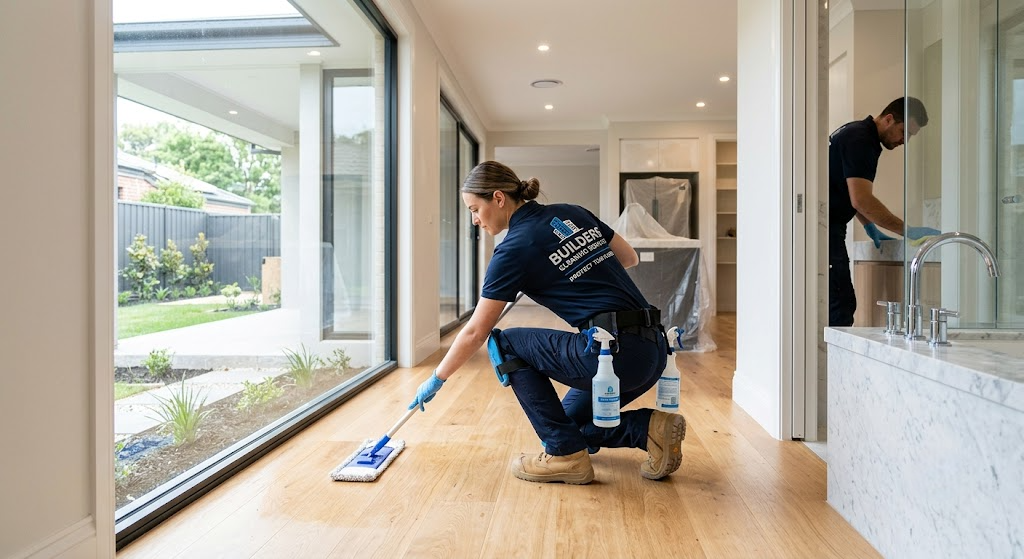
Table of Contents
- Your Floors Are Taking a Beating Right Now
- Windows: Where Damage Happens Fastest
- Fixtures and Fittings Get Forgotten
- The Order of Operations Actually Matters
- What This Costs You If You Skip It
- Contact Us White Glove Cleaning Services Today
- FAQs
Your Floors Are Taking a Beating Right Now
Every time someone walks across a dusty new floor, they’re dragging grit under their boots. That’s sandpaper. Not a metaphor. Actual abrasive particles being ground into your finish with every step.
And the damage isn’t instant, which is why it sneaks up on people. It’s a slow dulling. A haze. Six months later you’re wondering why the floor never looked as good as the showroom sample.
Timber and Vinyl
Fresh timber and vinyl are soft. Really soft. The protective coating hasn’t fully cured yet on a lot of finishes, so it scratches easily.
A proper builders clean lifts the grit off rather than pushing it around. Vacuum first, always. Then the right pH neutral product, because the wrong one strips the sealant and you’ll never quite get that sheen back.
Tile and Stone
Leave it a fortnight and it hardens into something that needs acid to shift. And acid on natural stone? Bad news. It etches. Permanently. Getting it off early with the right solution is the whole game.
Windows: Where Damage Happens Fastest
Paint flecks, plaster splatter, silicone smears, adhesive from the protective film. All of it bakes on in the sun. That’s the bit people miss. A splatter that would’ve wiped off with warm water on day three becomes a scraper job by week six.
Then there’s the tracks. Fine construction dust settles into window and door tracks and grinds against the seals every time you slide them. Cheap fix now. Expensive replacement later.
Professional crews use blades at the right angle with proper lubrication. Do it wrong and you leave hairline scratches across a whole pane of glass. Which you’ll see every single sunny day for the next twenty years.
Fixtures and Fittings Get Forgotten
Tapware, light fittings, door handles, switch plates, extractor vents. Nobody thinks about these until something stops working.
Brushed brass and matte black tapware are everywhere in New Zealand homes right now, and both are surprisingly fussy. Cement dust plus a scourer equals a ruined finish. There’s no fixing it. You replace the tap.
Vents and filters matter too. Your new heat pump or rangehood pulls construction dust straight into its filters from day one. That’s a warranty conversation waiting to happen, and it’s exactly the sort of thing a thorough post construction clean up sorts out before it becomes your problem.
The Order of Operations Actually Matters
You clean the windows, then someone vacuums the ceiling vents, and now there’s dust back on your glass. You mop the floor, then wipe down the cabinetry, and the runoff lands right back where you started.
Top down. Always. Ceilings, then walls and fixtures, then windows, then floors last. Multiple passes, because construction dust keeps settling for days after the work stops.
Most builders cleans need at least two visits for exactly this reason. If you’re trying to work out timing around your build schedule, this guide on how frequently a post build clean should happen breaks it down properly.
What This Costs You If You Skip It
Rough numbers. A single scratched window pane runs a few hundred to replace. Etched stone benchtop? Thousands. Refinishing a timber floor that’s been dulled by grit? You’re into four figures before you’ve started. And it’s not just homes. Commercial fit outs have the same issue, which is why plenty of businesses line up their handover clean with an ongoing arrangement. If that’s you, it’s worth understanding what separates a decent commercial cleaner from a poor one before you sign anything.
For Christchurch and wider Canterbury builds, the crew at White Gloves handles post build work across the region and knows exactly which surfaces cause the most grief.
Contact Us White Glove Cleaning Services Today
White Gloves can provide you with Builders Cleaning Services results in New Zealand.
Location: Christchurch, New Zealand (Office)
Telephone: +64 033905749
Email: Care@wgcs.co.nz
FAQs
1. When should Builders Cleaning happen?
Right after the last trade finishes and before furniture goes in. Empty rooms clean far better, and you avoid dust settling into new furnishings.
2. Does Builders Cleaning cover windows inside and out?
Usually yes, including tracks, frames, and sills. Worth confirming exterior glass is included when you book, especially on multi storey builds.
3. Can I clean tapware and fixtures myself afterwards?
You can maintain them, sure. But that first clean is the risky one. Cement residue needs specific products, and a wrong move on brushed or matte finishes can’t be undone.
4. How long does it take?
A standard three bedroom home usually takes a full day, sometimes two if there’s heavy residue. Larger commercial spaces take longer and often need staged visits.
5. Is it worth it for a small renovation?
Yes. Even a bathroom reno throws fine dust through the whole house. One clean protects everything it settled on.