

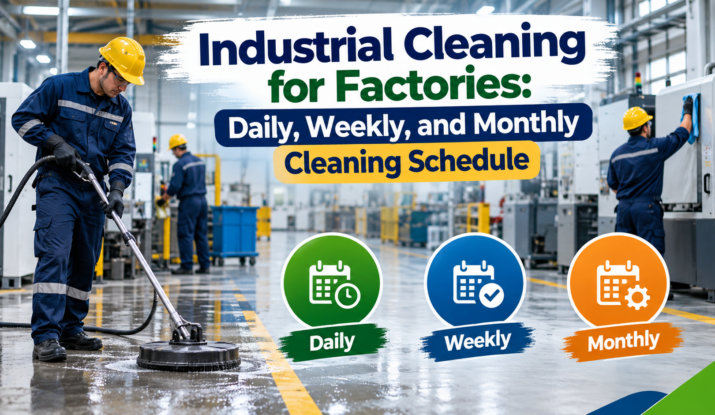
Let me keep this simple. Industrial cleaning is just the work of keeping a factory safe, tidy and running, done to a timetable instead of whenever someone finally snaps and grabs a broom. I’m with White Gloves Cleaning Services here in Christchurch, and we have different services like industrial sweeping, industrial scrubbing, floor maintenance, water blasting, window cleaning and builders cleans. So we’ve walked through a lot of factory floors around Canterbury. Some are spotless. Some are… not. The difference is almost never the size of the budget. It’s whether anyone wrote down who cleans what, and how often.
Here’s the schedule we usually recommend.
Table of Contents
- Why a Schedule Beats a Big Clean Up Day
- Daily Industrial Cleaning Tasks
- The Weekly Reset
- Monthly Jobs Most Factories Forget
- Who Does What?
- Signs Your Schedule Isn’t Working
- Contact Us White Gloves Cleaning Services Today
- FAQs
Why a Schedule Beats a Big Clean Up Day
You know the drill. Nobody cleans properly for five weeks, then an audit gets booked and suddenly everyone’s on their hands and knees at 6am.
That approach costs more. Dust that sits turns into grease, grease turns into a slip hazard, and a slip near a forklift aisle is not a small problem. Housekeeping is part of your health and safety duties anyway. Might as well do it in small daily bites.
Daily Industrial Cleaning Tasks
Daily work should take one person somewhere between 30 and 90 minutes, depending on your floor area. Anything longer and you’re probably fixing yesterday’s skipped job.
Floors and Walkways
Sweep or machine sweep the main traffic lanes. Every single day. Keep pedestrian walkways and forklift routes clear, because that’s where most near misses happen. Spot mop anything sticky before it dries hard.
Machines and Workstations
Wipe down machine guards, control panels and benches at the end of each shift. Clear swarf, offcuts and packaging waste. Vacuum dust from motors and vents, and please use a vacuum rather than compressed air if the dust is fine. Blasting it into the air just moves the problem onto someone’s lungs.
Bins, Spills and the Lunchroom
Empty bins before they overflow. Deal with spills straight away using your spill kit, not a couple of paper towels and hope. And yes, clean the lunchroom and the toilets. Staff notice this stuff more than management thinks.
The Weekly Reset
Weekly is where the real difference shows up.
Scrub the Floor Properly
Sweeping picks up loose debris. It doesn’t touch the thin film of oil and rubber that builds up under traffic. A ride on or walk behind scrubber with the right pad and detergent will lift it. Skip this for a few months and your concrete slowly goes from grey to almost black, and nobody can pinpoint when that happened.
Look Up
Walls, racking uprights, pipework, ledges and light fittings. Dust sits on all of them, then drops onto your product at the worst possible moment. Weekly in dusty areas, fortnightly if you’re clean and dry.
Monthly Jobs Most Factories Forget
Monthly is for the big, slightly annoying stuff:
- Outside areas. Loading bays, footpaths and yard concrete pick up oil, moss and tyre marks fast. High pressure cleaning sorts it, and the same approach that strips grime off a stained driveway works on a loading dock.
- Windows and skylights. Cheap lighting upgrade, honestly.
- Drains, gullies and grease traps. Before they smell, not after.
- Extraction, vents and filters. Check, clean or replace on the manufacturer’s advice.
- Racking, mezzanines and behind the machines. The places nobody walks past.
If your site makes food, does coatings, or handles fine powders, some of these move up to weekly. Your call, based on what you actually produce.
Who Does What?
Simplest split we’ve seen work: your staff own the daily tasks, a contractor owns the weekly scrub and the monthly list.
Why? Because production teams are good at wiping their own station and terrible at finding four spare hours for racking. Not a criticism, just how shifts go. Our cleaning crew handles Canterbury sites on fixed schedules for exactly this reason, and you can see the full range of work we take on if you’re unsure where your site fits.
Write the split on one page. Stick it on the wall. Done.
Signs Your Schedule Isn’t Working
- Floors look grey and dull even right after a clean
- Dust reappears within hours of wiping
- People keep saying “I thought the cleaners did that”
- Your last audit had housekeeping notes on it
Any two of those and it’s time to rebuild the schedule rather than nag harder. And if a site has been let go for a year or more, a routine clean won’t fix it. You’ll need a one off reset first, a bit like the gap between a standard tidy up and a proper deep clean.
Contact Us White Glove Cleaning Services Today
White Gloves can provide you with Industrial cleaning results in New Zealand.
Location: Christchurch, New Zealand (Office)
Telephone: +64 033905749
Email: Care@wgcs.co.nz
FAQs
1. What is industrial cleaning?
It covers the heavy duty work factories, warehouses and workshops need: machine sweeping, floor scrubbing, degreasing, high level dusting and water blasting. At White Gloves Cleaning Services we do this across Christchurch and wider Canterbury, on daily, weekly or monthly contracts.
2. How often should a factory floor be scrubbed?
Weekly for most sites. Busy areas with oil or heavy forklift traffic may need twice a week. Low traffic storage can stretch to fortnightly.
3. Can our own staff handle it instead?
For daily tasks, yes, and they usually should. Scrubbing machines, high level access and pressure washing are where a contractor makes more sense.
4. Does industrial cleaning have to stop production?
Rarely. Most of our work happens after hours, on weekends or during shift changeovers, so the line keeps moving.
5. How much does it cost in New Zealand?
It depends on floor area, how dirty the site is and how often you want us in. A walkthrough and a fixed quote take about 20 minutes, free of charge.